“Quit while you’re ahead” is probably the most common piece of slot advice. In Bet 10, 100 or 1,000 Credits a Spin? we saw plenty of players double up and then give it all back. So if you stop as soon as you reach a profit target, do you end up better off? We compared four ways to play, simulating 2,000 players for each.
Key findings
- Stopping at a 10% profit let 80.8% of players walk away ahead.
- But nearly everyone who missed the target went bust, so on average each player still lost 424 credits.
- All four approaches returned around 97%. A stop-win target doesn’t change the machine.
- Quitting while ahead loses less on average only because you spin fewer times.
How We Tested
- Every player starts with 10,000 credits and bets a flat 100 credits per spin.
- Four approaches: stop at +10% (11,000 credits), stop at +20% (12,000 credits), stop at +50% (15,000 credits), and no stop-win target, playing the full 1,000 spins.
- Up to 1,000 spins per player. A player who can’t cover the next bet has gone bust.
- 2,000 players per approach, with the same machine settings as the homepage slot, 97% RTP.
The Four Approaches Compared
| Approach | Finished Ahead | Went Bust | Avg. Win/Loss per Player | Return |
|---|---|---|---|---|
| Stop at +10% | 80.8% | 18.5% | −424 | 97.07% |
| Stop at +20% | 70.9% | 27.7% | −807 | 96.49% |
| Stop at +50% | 52.2% | 39.6% | −1,282 | 97.00% |
| Never stop, play all 1,000 spins | 33.3% | 48.3% | −2,518 | 96.70% |
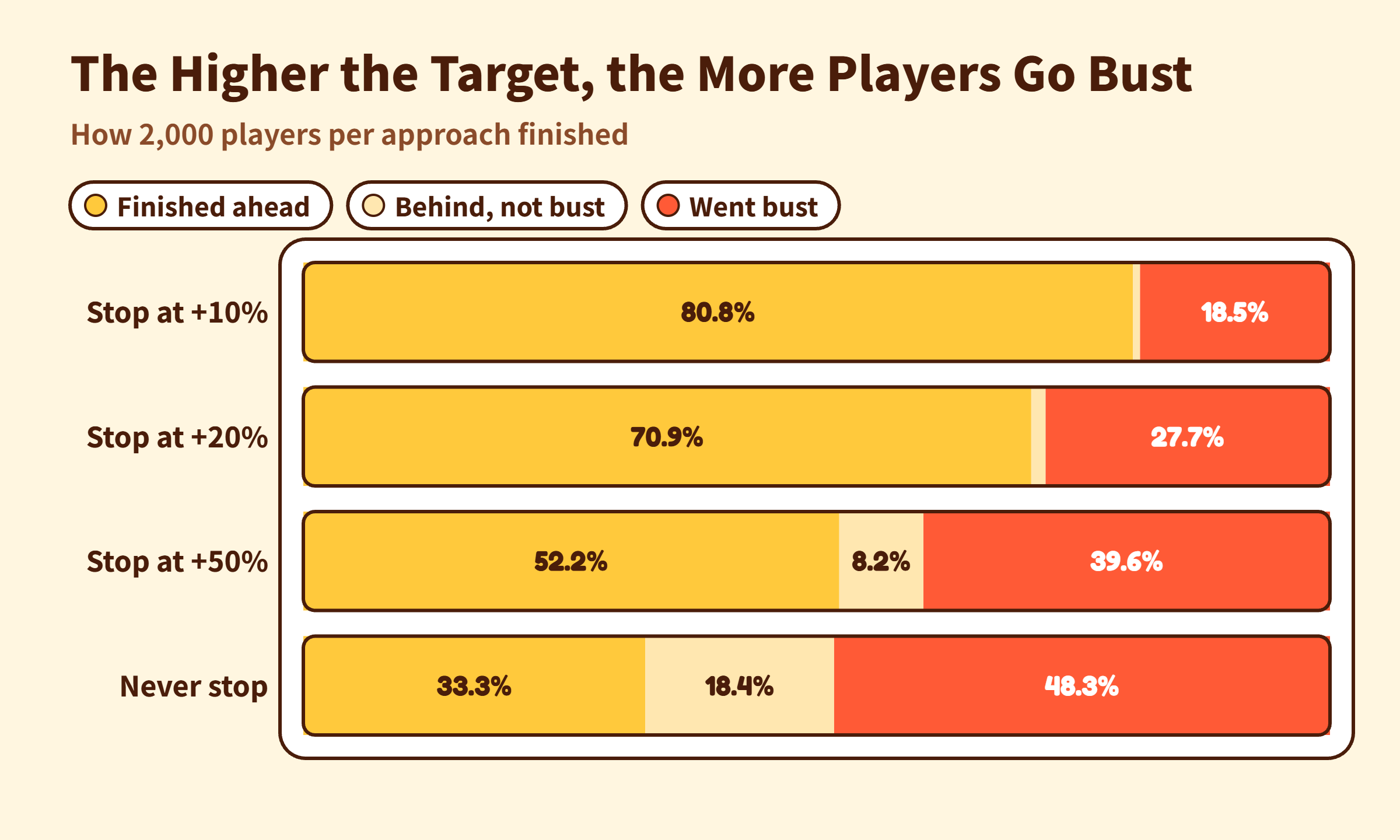
The lower the profit target, the more players leave with a profit and the smaller the average loss. The higher the target, the closer the results get to the “never stop” group.
Stop at +10%: 80% Win a Little, 20% Lose It All
This looks like the “best” of the four: 8 out of 10 players walked away with a profit. But look closely at the amounts on each side:
- Players who hit the target were mostly up only about 1,000 credits (a little more if they landed a big win).
- Players who missed the target almost all lost the full 10,000 credits.
It takes a lot of 1,000-credit wins to make up for a single 10,000-credit loss. Averaged across all 2,000 players, each one still lost 424 credits. “A high chance of winning” and “winning on average” are two different things.
Why Can’t a Stop-Win Target Beat 97%?
Look at the last column of the table: all four approaches returned between 96.5% and 97.1%. Whenever you stop, every 100 credits you wager still pays back only about 97 on average. A stop-win target changes when you leave, not the expected value of each spin.
So why do players who stop early lose less? It mostly comes down to how many times they spin.
- Players who stopped at +10% made only 145 spins on average.
- Players who never stopped made 764 spins on average.
At 100 credits a spin, each spin loses 3 credits on average. 145 spins works out to about 435 credits lost, and 764 spins to about 2,300, roughly matching the average losses in the table. The savings don’t come from “good timing”. They come from spinning far fewer times.
A Stop-Win Target Changes How Results Are Spread
What a stop-win target really does is redistribute the results. If what you care about is “leaving happy most of the time”, it does help. But if you think it will make you a long-term winner, the data says no.
- No target: results are spread out. Some win big, some lose a little, and nearly half go bust.
- Stop at +10%: results split into two groups. Most players “win a little” and a minority “lose everything”.
Something More Useful Than a Stop-Win Target
Instead of waiting to be ahead before you stop, decide two things before you start:
- How long you’ll play: for example 200 spins or 30 minutes, then stop.
- How much you’re willing to lose: for example stop once you’ve lost half your credits, and don’t chase it back.
These two limits directly cap the number of spins and the worst-case outcome, which controls losses better than a stop-win target. On the flip side, raising your bet to win back losses is another common trap. See our test in Does the Martingale Strategy Work?
Want to try a stop-win target yourself? Set a goal and spin the slot machine on the homepage. To learn how RTP is calculated, read What Are RTP, Hit Rate and Volatility?
*Simulated on November 12, 2026 using the same game engine and settings as this site’s slot machine (97% RTP), with 2,000 players per approach. This site offers free play only, and credits have no cash value.