“Double your bet after every loss, and one win gets it all back.” This approach, known as the Martingale strategy, is the “can’t-lose system” almost everyone who has played a casino game has heard of. It sounds like as long as you win once in the end, you recover every loss and make a little extra. Using the same engine as our slot machine, we had 10,000 players follow this method to see what actually happens.
Key findings
- Doubling with no limit: 100% of players went bust within 1,000 spins, typically around spin 18.
- With a 1,000-credit max bet: 63.1% were up 10% or more at some point, yet 91.8% went bust in the end.
- Control group with a flat 10-credit bet: nobody went bust, and the average loss was just 307 credits.
- The problem isn’t luck. This machine averages one win every 8.5 spins, so going a dozen or more spins without a win is normal.
What Is the Martingale Strategy?
There are only two rules:
- If you lose, double your next bet.
- If you win, go back to your starting bet.
On this slot machine, any win pays back at least 2x the bet (three Lottery Tickets on a line). So if you start at 10 credits and keep doubling, no matter how many spins you lose, one win recovers everything lost in that run plus about 10 credits. On paper it looks like a sure thing.
How We Tested
- Every player starts with 10,000 credits and a 10-credit opening bet.
- Up to 1,000 spins per player. If the balance can’t cover the next bet, the player bets everything left, and losing that means going bust.
- We compared three “raise after a loss” approaches with 10,000 players each, plus a control group of 2,000 players betting a flat 10 credits.
- 97% RTP, with the same machine settings as the homepage slot.
The slot machine’s bet options are 10, 50, 100, 200, 500 and 1,000 credits, so you can’t double exactly from 10 to 20 to 40. The first two “doubling” approaches were therefore simulated with the same engine. The third, “move up one bet option”, is the version you can actually test on the slot machine.
Results Overview
| Approach | Went Bust | Reached +10% at Some Point | Finished Ahead | Busted Players Typically Lasted | Avg. Win/Loss per Player |
|---|---|---|---|---|---|
| Flat 10-credit bet (control) | 0% | 29.0% | 36.8% | No one went bust | −307 |
| Doubling, no limit | 100% | 47.6% | 0% | To spin 18 | −10,000 |
| Doubling, 1,000-credit max bet | 91.8% | 63.1% | 8.1% | To spin 46 | −2,434 |
| Move up one bet option (10→50→100→200→500→1,000) | 93.3% | 63.7% | 6.6% | To spin 42 | −3,330 |
Why Does Doubling With No Limit Always Go Bust?
It comes down to how many losses in a row you can survive. Starting at 10 credits and doubling, here is what you need to bet and how much you’ve already lost:
| Losses in a Row | Next Bet | Already Lost This Run |
|---|---|---|
| 3 spins | 80 | 70 |
| 5 spins | 320 | 310 |
| 7 spins | 1,280 | 1,270 |
| 9 spins | 5,120 | 5,110 |
| 10 spins | 10,240 | 10,230 |

After 10 losses in a row, the next bet already exceeds the 10,000-credit bankroll. So how common are 10 losses in a row? We ran the same engine for 200,000 spins and measured the gap between every pair of wins:
| Spins Without a Win Between Two Wins | How Often It Happens |
|---|---|
| 5 or more spins | 53.5% |
| 9 or more spins | 32.4% |
| 10 or more spins | 28.7% |
| 15 or more spins | 15.2% |
| 20 or more spins | 8.2% |
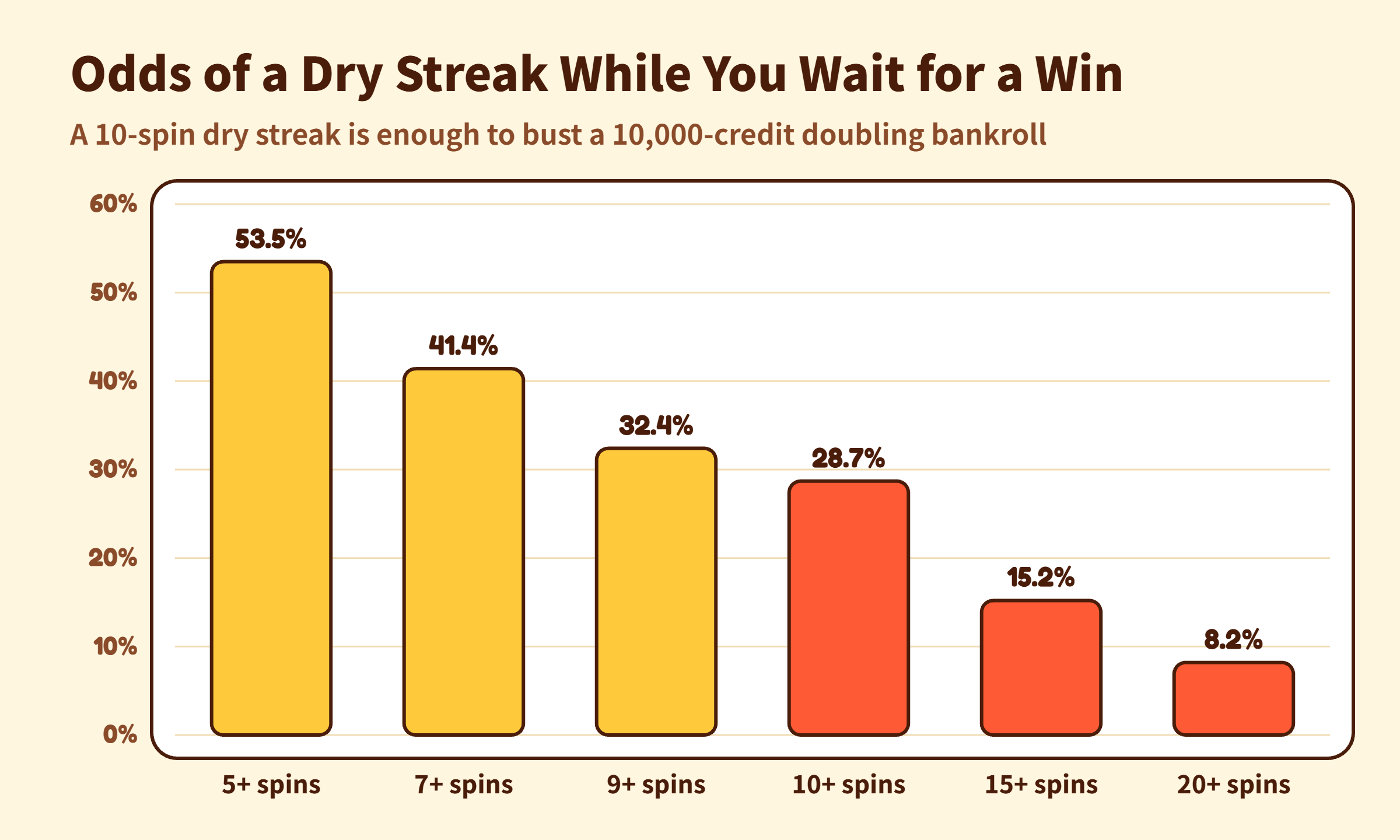
In other words, every time you wait for a win there’s roughly a 30% chance of going 10 or more spins without one. Each successful run only nets about 10 credits, but a single long dry streak wipes out everything. Over 1,000 spins you’ll wait for a win hundreds of times, and dodging every long streak is practically impossible. That’s why not one of the 10,000 players made it to the end.
With a Bet Limit: Sweet at First, Bitter Later
Real machines usually have a maximum bet, and ours tops out at 1,000 credits. With that limit in place, the results look different:
- 63.1% of players reached 11,000 credits or more at some point, and half of them peaked at 3,870 credits ahead or more.
- But once the bet is capped at 1,000 credits, a single win can no longer recover earlier losses, and the balance starts draining fast.
- In the end 91.8% went bust, typically around spin 46.
This is exactly why the Martingale “feels like it works”: at first you really do win, and steadily. Only when a long dry streak hits do you realize the few thousand credits you’d built up don’t come close to covering one losing run. Would stopping at a profit target help? Read Does Quitting While You’re Ahead Work?

Results Using the Slot Machine’s Bet Options
If you try this on the slot machine, the closest you can get is moving your bet up one option after every loss, 10→50→100→200→500→1,000, and going back to 10 after a win. The results are about the same as doubling: 63.7% were up 10% at some point, 93.3% went bust in the end, and the average player lost 3,330 credits. In other words, whether it’s strict doubling or any variation of “raise after a loss”, the outcome is about the same. As long as your bet grows with your losses, one long dry streak will take it all back.
Why Is the Martingale Especially Bad on Slots?
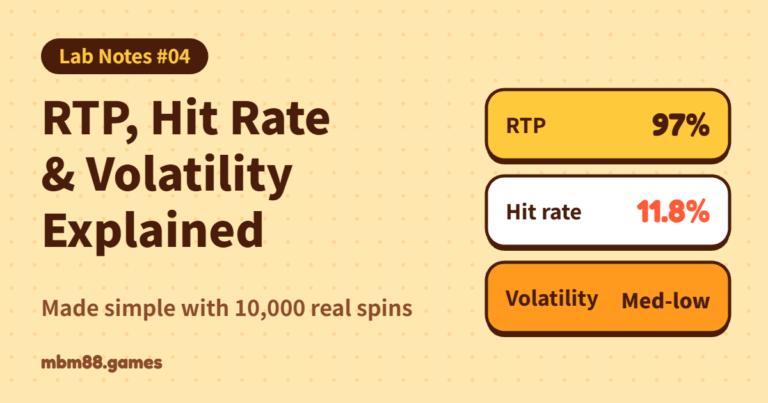
The Martingale originally caught on with near 50/50 bets like red or black in roulette, where you win close to half the time and 10 losses in a row are fairly rare. This slot machine’s hit rate is only 11.75%, so going a dozen or more spins without a win is routine and doubling can’t keep up. Most importantly, however you adjust your bet, every spin still returns 97%. A betting strategy can only change how wins and losses are spread and how fast the session ends. It can’t change the machine itself.
Try It Yourself
Head to the slot machine on the homepage, start at 10 credits and move your bet up one level after every miss, and see how many spins you last. You can reset when your credits run out, which is the biggest advantage of free play: you get to watch the strategy fail with credits you can’t actually lose. To see why bigger bets make going bust so much more likely, compare Bet 10, 100 or 1,000 Credits a Spin? For what hit rate and volatility mean, read What Are RTP, Hit Rate and Volatility?
*Simulated on November 12, 2026 using the same game engine and settings as this site’s slot machine (97% RTP), with 10,000 players for each of the three raising approaches and 2,000 in the control group. This site offers free play only, and credits have no cash value. Please read our Responsible Gaming statement.